
Established in 2014, the Maryland-National Capital Region Emergency Response System (MDERS) serves as the single point of collaboration between fire, rescue, emergency medical services, law enforcement, emergency management, and hospitals within Montgomery and Prince George’s Counties. MDERS is dedicated to supporting its stakeholders by leading the development and implementation of essential response capabilities that safeguard more than two million residents and visitors in the Maryland-National Capital Region. Working alongside a Steering Committee comprised of leaders from stakeholder agencies, MDERS identifies key response capabilities that need further enhancement and expansion. These priorities and their objectives are detailed in the MDERS Strategic Plan, which directs all planning, organization, equipment, training, and exercise investments for each fiscal year.
From June 1, 2025, through May 31, 2026, MDERS assisted its stakeholders in developing and enhancing response capabilities through the provision of plan and policy development, training and exercise development and delivery, and equipment acquisition to support the missions of its partner agencies.
Investment Overview
Training and Exercise Program
MDERS’s Training and Exercise Program offers numerous opportunities for stakeholders to develop and enhance capabilities through in-person, virtual, and hybrid curricula. Throughout this fiscal year, MDERS supported the attendance of 512 stakeholders at 26 conferences and 32 training opportunities. Attendees were provided with the unique opportunity to learn from discipline-specific subject matter experts (SMEs) on a variety of topics, including breaching techniques, tactical maneuvers, close quarters combat, structural rope rescue techniques, austere medical training, and many more. MDERS also assisted planning initiatives related to Community Reception Centers (CRCs), Rescue Task Force (RTF), Emergency Vehicle Operations Course (EVOC). Additionally, MDERS supported the development and execution of HERoes on the Horizon (a week-long summer camp to empower girls interested in public safety and emergency management careers), Maryland Region V Healthcare Coalition’s DisasterPiece two-day conference, and the National Executive Forum on Public Order Policing (NEFPOP).
Exercises are also an important component of MDERS’s work. During this past fiscal year, MDERS developed the following exercises in coordination with stakeholders:
- A Washington Gas Tabletop Exercise (TTX) Series that examined response operations to a rail car fire and an active shooter incident at the organization’s Rockville facility.
- A MCFRS Rail TTX that evaluated the immediate response to a passenger train derailment.
- An active assailant TTX scenario at a mall for the Montgomery County Police Department’s (MCPD) Executive Series.
- A public order TTX for District V officers of the Prince George’s County Police Department (PGPD) to coordinate with federal partners in managing an escalating situation outside of Joint Base Andrews.
- A Cybersecurity Exercise with the Montgomery County Office of Emergency Management and Homeland Security (MC OEMHS).
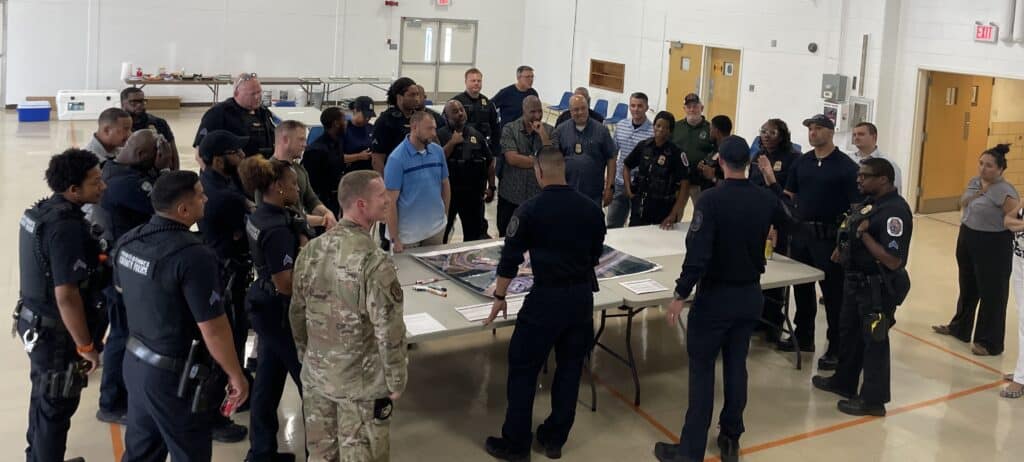
PGPD District V Public Order TTX
Emergency Management Response and Recovery Professional Services
MDERS supported the diverse missions and functions of the Prince George’s County Office of Homeland Security and Office Emergency Management (OHS/OEM) and MC OEMHS through the provision of professional services and support equipment.
During the last fiscal period, OHS/OEM was able to continue the development of the Community Lifelines mobile application and integrate the data into dashboards at the county’s Emergency Operations Center (EOC). A broad range of training events were held with community partners that covered first aid and CPR, senior citizen outreach, disaster preparedness, community resiliency, and hazard mitigation. Several exercises were conducted pertaining to active assailant response, train derailments, and PGPD’s Continuity of Operations Plan (COOP). Software was also procured that will improve the agency’s damage assessment process to more reliably and accurately document the aftermath of incidents in the county.
OEMHS in the same period engaged with approximately 10,000 members of the community to share best practices of emergency preparedness through in-person and virtual settings. A National Preparedness Symposium was organized to focus on public safety, bringing together nonprofit organizations to engage residents with access and functional needs and disabilities by highlighting emergency preparedness programs, resources, and services available to support them before, during, and after emergencies. OEMHS updated its Volunteer and Donations Plan and the Community Organizations in Disasters (COAD) bylaws. Educational brochures and outreach material were produced to distribute vital information to organizations and residents. Mission support equipment, including televisions, conferencing equipment, and radios, were purchased to expand operational capabilities.
Montgomery County Emergency Operations Enhancements
Coordination and communication among public safety organizations are vital for holistic responses. Montgomery County is in the process of creating a Public Safety Joint Operations Center (PSJOC) to centralize key functions of public safety and promote interdisciplinary transparency and synergy. The PSJOC will gather the Police Operations Center, Real Time Intelligence Center, Drone as a First Responder, Fire and Rescue Operations Center, Emergency Medical Services (EMS) Transport Disposition Officer, Office of Emergency Management and Homeland Security Watch Desk, Resource Management System, and Public Warning System in a singular location. MDERS secured information technology (IT) platforms and technological components to promote cohesion among the various platforms and partners.
Emerging Homeland Security Technology Pilot
MDERS coordinates with stakeholders to identify innovative solutions that address emerging homeland security challenges. Annually, MDERS allocates 5% of its budget to this program, which focuses on evaluating innovative tools and technologies identified through first responder experiences. Detailed below are the technologies and equipment MDERS procured for MCPD, PGPD, and MC OEMHS.
High-speed pursuits are dangerous endeavors that can have fatal consequences. To reduce this risk, MDERS acquired StarChase technology for MCPD. This platform is a deployable, adhesive dart that law enforcement officers can launch and attach to a vehicle during a pursuit. Law enforcement can follow the vehicle at a safe distance using the GPS tracking embedded in the dart. This technology greatly reduces the potential harm to law enforcement and members of the community.
MCPD and PGPD conduct frequent training for officers to refine and hone their skills. These trainings require participants to wear protective gear to minimize the risk of injury. However, repeated use can put the equipment in a suboptimal condition and require labor-intensive, manual cleaning. A cleaning cabinet was procured for each department to sanitize and deodorize the equipment to improve officer wellness while lessening the labor required for cleaning the equipment.
Additional computer hardware was secured for Montgomery County’s PSJOC. This investment was made in parallel to the procurements secured in the Montgomery County Emergency Operations Enhancements capability.
Public Health Emergency Response
MDERS funded various efforts to improve planning and community outreach at the Montgomery County Department of Health and Human Services (DHHS) and Prince George’s County Department of Health (PGHD). DHHS conducted exercises that examined response efforts related to medical countermeasures and medical material management. The information gleaned from these exercises helped inform adjustments to relevant plans. Staff were also able to amend and complete revisions to the Information Sharing Plan, Lab Surge Plan, and Risk Communication Plan. In Prince George’s County, the health department held public engagement events and amended its Medical Countermeasures Plan, Strategic National Stockpile Plan, and Communications Plan. These efforts better position both departments to respond to a multitude of public emergencies.
Law Enforcement Equipment
MDERS closely collaborates with MCPD and PGPD to procure equipment to augment their Special Operations Division (SOD). To support MCPD, a Special Operations Logistics Van was purchased to add to their existing fleet. This van can be used to efficiently move personnel and equipment to events throughout the National Capital Region (NCR). MDERS also supported the upfitting of three MCPD vans to enhance their operational deployment capabilities and safety features.
MDERS was able to procure body armor plates for PGPD officers. These new plates will increase officer safety from the threat of penetrating trauma. Two non-ballistic towers were obtained for PGPD to bolster situational awareness during large-scale events. The towers are easily deployable with a scissor lift to elevate personnel in an enclosed space to view an area from a higher vantage point. Each tower is adorned with cameras to enable a continuous 360-degree surveillance area for law enforcement personnel.
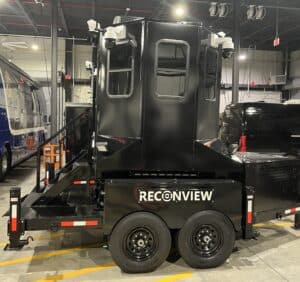
Non-Ballistic Tower
Command Competency Lab Enhancements
Training is a key repetitive function for all emergency partners. MCFRS has created a Command Competency Lab to simulate a multitude of emergencies and evaluate officers’ ability to manage the incident. To enhance the lab, MDERS worked with MCFRS to identify equipment to improve the lab’s functionality and increase the realism of the scenarios. A computer tablet was obtained for MCFRS to use during the evaluation portion of the training. Evaluators are able to seamlessly take notes and reference documents while having the needed mobility during training.
Investments were made to improve the overall authenticity of scenarios within the Command Competency Lab. Thermal imagers were acquired to reflect actual expected actions and require participants to use the proper equipment. Similarly, entry props and smoke machines were added to the lab to simulate real-world obstacles and mimic sensory realism. A generator was purchased to power the new equipment and a large storage container was integrated into the space to efficiently store all lab supplies.
EMS Mobile Clinical Competency
Training and certification are necessary to maintain a cadre of qualified medical professionals. PGFD maintains a mobile clinical component to reach a broad portion of its personnel and minimize travel logistics. Continuing with an investment that began a few years ago, MDERS supported this initiative by financing the upfitting of a department van. Shelving and compartments were incorporated into the vehicle for equipment storage. Medical supplies and patient litters were bought to complement the program’s medical inventory. A 3-D printer was procured for the creation of custom props and equipment to improve the overall quality of training and evaluations.
Acts of Violence Incident Training Lab
Immediate medical intervention is paramount to reduce the threat of permanent injury or loss of life. Active assailant situations are complex events that can often delay and inhibit the administration of needed medical care. PGPD and PGFD have been jointly training to integrate medical personnel into law enforcement teams to reach victims more quickly in these challenging environments. Medical supplies, manikins, and bleeding control trainers were obtained to help both departments in their training endeavors in this vital area.
Prince George’s County Hazardous Weather Preparedness
Natural disasters pose a severe threat to communities. In particular, flooding can cause immeasurable harm. MDERS purchased weather stations for the Prince George’s County OHS/OEM to be strategically placed at high-risk flood-prone areas within the county. These stations have a flood sensor, rain gauge, and camera to monitor and collect all relevant data to support the department’s internal and regional weather modeling and early warning notification systems.
Structural Collapse Equipment
Structural collapse emergencies are intricate operations. Intensive training and specialized equipment are required for an effective response. MDERS procured backpacked torches and cutting rods, night vision binoculars, Paratech Rescue Guardians, and training manikins to enhance the existing capabilities of the Montgomery County Fire and Rescue Service (MCFRS) and Prince George’s County Fire/EMS Department (PGFD).
The backpacked torches and cutting rods are a lightweight and portable system that allows operators to work in confined spaces. Night vision binoculars improve visibility for personnel and commanders in low-light situations. Lastly, the Paratech Guardian Systems are monitoring and alarm devices that detect changes in weight, deviations in structural inclines, and seismic activity. The equipment procured bolsters the current equipment cache of each department and improves their overall response capabilities.
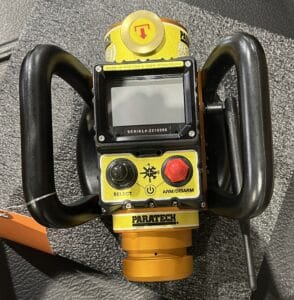
Paratech Rescue Guardian
Medical care in the compressed landscape of a structural collapse incident can be an incredibly difficult process. It is important for personnel to prepare for the numerous challenges in these situations. Durable manikins were obtained for each department for technician training in restrictive spaces.
Evolv Detection Systems
Threats to hospitals have dramatically escalated in recent years. As public-facing entities, hospitals face challenges in screening individuals who pose a significant threat to a facility and its personnel. In partnership with Maryland-National Capital Region medical facilities, MDERS procured two Evolv detection devices. These devices use sensors and artificial intelligence to identify individuals who may be carrying weapons or other prohibited items when entering a facility. Early threat identification is paramount to preventing hostile acts before they occur. The two systems are placed at Adventist HealthCare’s White Oak Medical Center and Fort Washington Medical Center.
Representation in Regional Activities
MDERS represented its stakeholders by holding positions on regional committees hosted through the Metropolitan Washington Council of Governments (MWCOG). As a conduit between the local jurisdictions and the larger National Capital Region (NCR), MDERS minimized the burden on stakeholder agencies while ensuring their interests are represented and supported through regional funding. MDERS staff members participated in meetings and activities, including involvement in Regional Emergency Support Function (RESF) Committees; Regional Programmatic Working Groups; Regional Planning Guidance Working Group; the NCR Emergency Response System; and the NCR Homeland Security Executive Committee (HSEC), Policy Group, and Advisory Council.