Training is a critical function that enables organizations to evolve, adapt, and prepare for a wide range of emergencies. The Montgomery County Fire and Rescue Service (MCFRS) recently identified the need for enhanced training to evaluate the department’s capability to administer advanced life support (ALS) during technical rescue (TR) incidents. The unique factors in this field necessitate specialized equipment to replicate realistic scenarios. As part of this pilot course, MCFRS used a manikin that was procured by the Maryland-National Capital Region Emergency Response System (MDERS). The integration of the advanced manikin into an innovative training program underscores strong collaboration and a shared desire to improve response capabilities between MDERS and its partners.
Technical rescue is a branch of fire/rescue operations that pertains to four areas: trench, confined space, rope, and structural collapse (MCFRS, 2019). This discipline has characteristics that include low-frequency events that normal personnel are not fully accustomed to and may lack the requisite skills to respond effectively to incidents, involve more extreme dynamics at greater heights and depths, and often require the use of complex mechanical systems (MCFRS, 2019). These unique factors require additional and specialized training to prepare a cadre of personnel in this field.
MDERS closely coordinates with all stakeholders to identify training and equipment to enhance each organization’s operational capabilities. MCFRS identified the need for additional manikins to support internal training initiatives. These manikins replicate an individual’s height and weight and allow practitioners to practice ALS skills on a simulated patient.
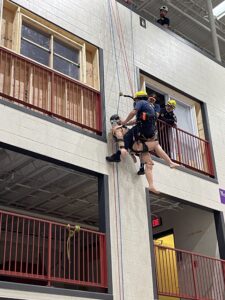
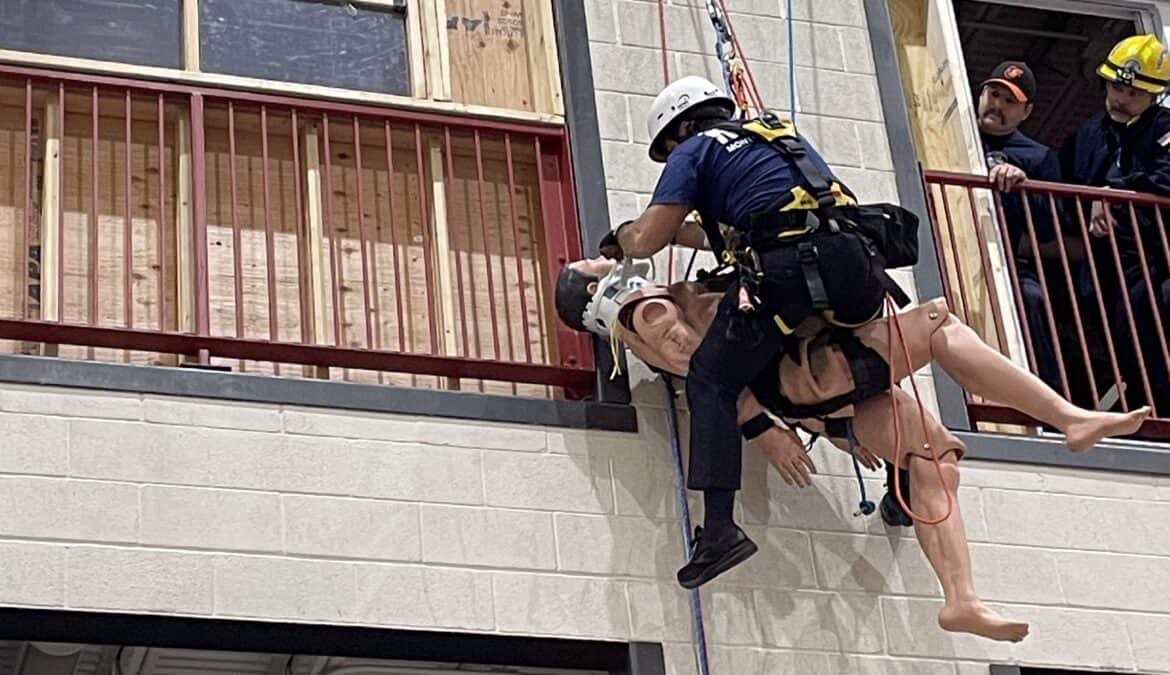
MCFRS is in the initial phase of developing an advanced TR course designed to apply ALS skills in difficult and austere environments. This phase challenged TR paramedics’ ability to administer ALS care during a high-angle rope rescue operation. Participants went through classroom instruction and practiced their skills during the hands-on portion of the training. Each participant delivered patient care and executed techniques that included airway management, medication administration, hemorrhage control, and the use of treatment and diagnostic equipment, all while suspended in the air.
This training initiative highlights MCFRS’s dedication to hone their skills in unique and challenging situations and the commitment of MDERS to support their stakeholders with the necessary equipment and training.
Source
Montgomery County Fire and Rescue Service (MCFRS). (2019). Incident Response Policy Appendix J Initial Actions for Technical Rescue Incidents. chrome-extension://efaidnbmnnnibpcajpcglclefindmkaj/https://www.montgomerycountymd.gov/frs-ql/resources/files/swsj/policyprocedures/admin/IRP_Appendix_J_Technical%20Rescue.pdf